
Most small businesses are active on social media but still struggle to see real results. They post regularly, reply to comments, and try different formats, yet engagement stays flat and sales rarely follow. The problem is rarely effort. It is the absence of a clear plan. Only 55% of businesses have a documented social media strategy, which makes measuring return on investment nearly impossible. This guide explains what a social strategy actually is, why it matters more than ever in 2026, and how to build one that turns your social activity into genuine business growth.
Table of Contents
- What is a social strategy?
- Why having a social strategy matters
- Core elements of an effective social strategy
- Proven social strategy tactics for 2026
- The real challenge: Strategy is more about focus than activity
- Build and refine your social strategy with EasiSocial
- Frequently asked questions
Key Takeaways
| Point | Details |
|---|---|
| Strategy, not just posting | A true social strategy is a focused, long-term plan—not just activity on every platform. |
| Quality wins over quantity | Concentrating efforts and using the 80/20 rule delivers better engagement and ROI. |
| Measure what matters | Monitor saves, shares and conversions to track real business impact—not just likes. |
| Data and iteration are key | Let real-world results guide ongoing improvements to your social strategy. |
What is a social strategy?
A social strategy is not simply having a Facebook page or posting three times a week. It is a long-term, goal-oriented plan that defines who you are trying to reach, what you want to say, how you will engage, and how you will measure success. Think of it as the difference between driving with a map and driving with your fingers crossed.
Many small business owners and marketing consultants confuse activity with strategy. Posting consistently is a tactic. Running a giveaway is a tactic. A strategy is the framework that decides which tactics to use, why you are using them, and what success looks like when they work. Without that framework, you are essentially guessing.
A well-built social strategy rests on four core pillars:
- Audience targeting: Who are you speaking to, what do they care about, and where do they spend their time online?
- Content direction: What types of content will you create, and what tone, format, and frequency will you use?
- Engagement methods: How will you respond to comments, build community, and encourage conversation?
- Metrics: What will you measure to know whether your strategy is working?
“A social strategy is not about being everywhere. It is about being exactly where your audience is, with the right message, at the right time.”
Here is a quick comparison to make the distinction crystal clear:
| Activity (no strategy) | Strategy-led approach |
|---|---|
| Posting daily with no clear goal | Posting with intent tied to business objectives |
| Chasing follower counts | Tracking saves, shares, and conversions |
| Using every platform available | Concentrating on two or three key platforms |
| Creating content by gut feel | Using the 80/20 content rule to guide output |
| Reacting to trends randomly | Using social listening to plan ahead |
The 80/20 rule in social media means roughly 80% of your content should inform, entertain, or educate your audience, while only 20% should directly promote your product or service. This balance keeps your audience engaged without feeling constantly sold to. Pair that with selective platform use and AI tools to speed up production while keeping your voice authentic, and you have the foundation of a modern social strategy.
Why having a social strategy matters
Without a strategy, your social media efforts are expensive in the worst currency possible: time. Small business owners rarely have hours to spare, and spending them on content that does not connect with the right people is a drain that compounds over months and years.

The research backs this up. Only 55% of businesses have a documented social media strategy, and among those without one, between 45% and 54% report serious difficulty measuring ROI. That is not a minor inconvenience. It means nearly half of businesses cannot tell whether their social media is helping or hurting.
Here is what operating without a strategy typically looks like in practice:
- Wasted effort: You create content that gets little traction because it was not designed for a specific audience or platform.
- Poor measurement: Without defined goals, you cannot tell what is working, so you keep repeating the same mistakes.
- Missed opportunities: Trends pass you by because you have no system for spotting and acting on them quickly.
- Inconsistent brand voice: Different people post different things, and your audience gets a confused picture of who you are.
- Burnout: Posting without direction feels exhausting and pointless, which leads to inconsistency or giving up entirely.
“Businesses that document their social strategy are far more likely to report positive ROI and clearer audience growth than those that operate without one.”
The flip side is equally compelling. When you do have a strategy, every post has a purpose. You know which platforms to prioritise, what content to create, and how to measure whether it is working. You also make better use of tools like AI for social media, which can dramatically cut the time it takes to plan, create, and schedule content without sacrificing quality.
A strategy also gives you something to review and improve. Rather than starting from scratch each month, you build on what worked and cut what did not. Over time, that iterative approach compounds into a genuinely strong social presence.
Core elements of an effective social strategy
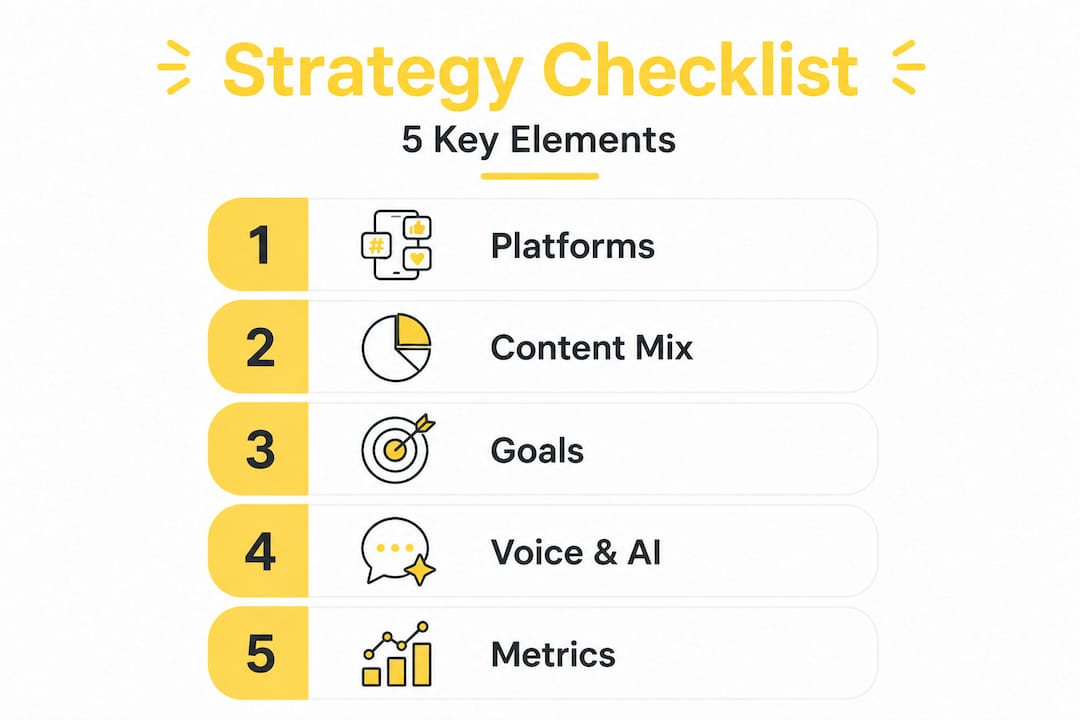
Building a social strategy from scratch can feel overwhelming, but it becomes manageable when you break it into clear components. Here is a practical framework you can apply immediately.
1. Choose your platforms wisely
Resist the urge to be everywhere. Concentration beats coverage every time, particularly for small businesses with limited resources. Pick two or three platforms where your target audience is most active and where your content format performs well. A B2B consultant might prioritise LinkedIn and YouTube. A local café might focus on Instagram and TikTok. The key is fit, not volume.
2. Define your content mix using the 80/20 rule
As mentioned earlier, 80% of your content should add value to your audience without a direct sales pitch. The remaining 20% can promote your offers, services, or products. This ratio keeps your feed interesting and builds trust over time. You can explore how the Pareto principle applies to content to sharpen this approach further.
3. Set measurable goals
Vague goals produce vague results. Instead of “grow our Instagram,” try “increase Instagram saves by 20% over the next 90 days.” Specific, time-bound targets give you something concrete to work towards and evaluate.
4. Use AI tools without losing your voice
AI can help you generate ideas, repurpose content, and schedule posts more efficiently. The risk is sounding generic. Always review AI-generated content and add your brand’s personality before publishing. The social management kit features at EasiSocial are built with this balance in mind, helping you move faster without losing authenticity.
5. Track the right metrics
Here is a table showing which metrics actually matter versus those that simply look impressive:
| Vanity metric | Meaningful metric |
|---|---|
| Likes | Saves and shares |
| Follower count | Engagement rate |
| Impressions | Click-through rate |
| Video views | Watch time and replays |
| Post reach | Conversions and leads |
Pro Tip: Prioritise saves and shares above all other engagement signals. When someone saves your post, they are telling the algorithm it is genuinely valuable. When they share it, they are doing your marketing for you. These two actions are the clearest indicators that your content is resonating.
Proven social strategy tactics for 2026
Theory is useful, but tactics are where strategy comes to life. Here are the approaches that are delivering results for small businesses right now.
User-generated content and micro-influencer partnerships
User-generated content (UGC) refers to posts, reviews, photos, or videos created by your customers rather than your brand. It is one of the most powerful tools available because it is authentic and trusted. UGC boosts conversions by 29%, and micro-influencer partnerships (with creators who have between 1,000 and 100,000 followers) deliver an average ROI of £5.20 for every £1 spent. For small businesses, this is a highly cost-effective alternative to traditional advertising.
Short-form video dominance
Short-form video continues to outperform every other content format in terms of reach and engagement. Platforms like TikTok, Instagram Reels, and YouTube Shorts reward consistent, watchable video content with significant organic reach. You do not need a film crew. A smartphone, good lighting, and a clear message are enough to get started. The key is to hook viewers in the first two seconds and deliver genuine value within the first 15.
Social listening for smarter planning
Social listening means monitoring conversations, hashtags, and trends across social platforms to understand what your audience is talking about right now. Tools that track mentions, keywords, and competitor activity give you a real-time picture of what content is resonating in your industry. This removes the guesswork from content planning and helps you respond to trends before they peak.
Optimise for saves and shares, not just likes
We touched on this in the previous section, but it deserves its own tactical focus. Actively design content to be saved or shared. Checklists, how-to guides, infographics, and opinion posts all tend to generate saves. Relatable, funny, or surprising content tends to get shared. Build your content calendar around these formats and watch your organic reach grow.
“The businesses seeing the strongest results in 2026 are not the ones posting the most. They are the ones posting with the clearest intent and measuring the outcomes that actually matter.”
Iterate based on data, not guesswork
Review your analytics at least once a month. Look at which posts generated the most saves, shares, and clicks. Ask why they worked. Was it the format? The topic? The timing? Then do more of that. Strategy without review is just a plan. Strategy with regular review becomes a competitive advantage.
Pro Tip: Set a monthly “strategy hour” in your calendar. Spend 30 minutes reviewing your top-performing content and 30 minutes planning the next month based on those insights. This single habit separates businesses that grow from those that plateau.
The real challenge: Strategy is more about focus than activity
Here is something most social media guides will not tell you: the biggest obstacle for small businesses is not a lack of ideas or tools. It is the inability to stop doing too much.
When resources are limited, the instinct is to spread effort across as many platforms as possible, hoping something sticks. It rarely does. Concentration is more effective than trying to maintain a presence everywhere, and yet the “be everywhere” approach remains the default for most small businesses. The result is mediocre content across five platforms instead of excellent content on two.
The second mistake is posting by gut feel rather than using data to guide decisions. Many business owners have a sense of what their audience likes, but that intuition is often wrong or incomplete. A single month of proper analytics review will almost always reveal surprises: the post you thought was weak outperformed everything else, or the format you invested the most time in barely registered. Data-driven iteration beats gut feel every time.
Documentation is the third missing piece. A strategy that lives only in your head is not really a strategy. Write it down. Even a one-page document that outlines your target audience, chosen platforms, content mix, and key metrics is enough to create accountability and consistency. Revisit it quarterly, update it based on what you have learned, and share it with anyone who contributes to your social media.
The businesses that consistently win on social media are not the ones with the biggest budgets or the most creative teams. They are the ones that focus, document, measure, and adapt. Applying the 80/20 rule to your content planning is one of the simplest ways to start this process, cutting wasted effort and concentrating your energy where it counts most.
Build and refine your social strategy with EasiSocial
Knowing what a social strategy looks like is one thing. Having the tools to build and maintain it consistently is another entirely.
EasiSocial is an all-in-one social management kit designed specifically for small businesses and marketing consultants who want to move from reactive posting to strategic, results-driven social media. From content planning and scheduling to analytics and AI-assisted creation, it brings every element of your strategy into one place. If you are ready to stop guessing and start growing, the lifetime management offer gives you full access to the tools you need to put this framework into practice from day one. Strategy becomes much easier when the right infrastructure is already in place.
Frequently asked questions
How is a social strategy different from content planning?
A social strategy sets overall direction and goals, while content planning determines the specific details of what, where, and when to post. One is the map; the other is the route.
What mistakes do small businesses make with social strategy?
Most try to be on every platform, focus on vanity metrics like likes and followers, and never write their strategy down. Avoiding these pitfalls and concentrating on meaningful engagement signals leads to significantly better results.
Which social media platform should I focus on in 2026?
Choose the platform where your target audience is most active and where your content format performs best. Concentration on key platforms consistently outperforms spreading effort too thinly across many channels.
How do I measure if my social strategy is working?
Track saves, shares, and conversion actions rather than just likes, and compare your outcomes regularly against the goals you documented at the start. Tracking saves and shares gives you a far more accurate picture of real impact than surface-level engagement numbers.